
Working on El Grito I found myself unexpectedly obsessed with David Bowie. I’ve grown up in a rich but quite conservative musical heritage and Peter pushed Bowie as an example of what emerging might mean. He said it wouldn’t look the same in Cuba, but it might have some of the same smells. Well I went to see Vita Kará and I say its closer than you would think.
I’m thinking of the version of Bowie who arrived in 1972 as it’s biggest underdog and exited as its biggest star, in a Britain of power cuts and a brown-out of the electrifying 60s culture. Suddenly this angular creature appears in glitter and platform boots, calling himself an alien, alligator, rock and rolling bitch, and me a a pink monkey bird. The nerve! The idea that personality could be constructed so vividly that the culture would have no choice but to reorganise itself around it. A similar story is unfolding in Havana.
Walking through Havana to see Vita Kará, without street-lights, struggling to hail a cab to Vedado in a deepening fuel crisis, there’s sense of risk – will the show survive, will I get home. But inside Fábrica, though, there was nothing diminished about the atmosphere. The room was full, and in Havana right now, the fact that people come to concerts carries weight.
When Gabo Cárdenas – the renaissance man leading Vita Kará, its singer, director, conductor and business manager – stepped into the light — turquoise suit catching the glare, gold hat scaled almost beyond practicality — something shifted. It wasn’t just technical ability or vocal range. It was intent. The sense that this was not simply a talented singer navigating difficult circumstances, but a man deliberately constructing himself in full view of everyone watching.
The First Time
The first time I saw him wasn’t at Fábrica. It was months earlier at the National Museum of Fine Arts, at a concert by the young string ensemble Ethernum. It was one of those evenings where the audience sits upright, the lighting is careful, and the atmosphere leans toward the classical idea of culture — respectful, composed, when something different entered the room. An elastic voice, moving between registers, sultry and slightly mischievous. He sang just one song and I went home curious, more at what I had seen than heard.
I started listening. The recordings felt like a conversation between Havana and somewhere else. Jazz slipping into son. Soul textures brushing against bolero tenderness. Funk rhythms braided with unmistakably Cuban pulse. Vocals in some places high and unnatural, sweet in others. It wasn’t traditional in the nostalgic sense, and it wasn’t foreign imitation either. It felt restless, as if testing how much space it could occupy.
And I found myself asking a question I didn’t expect – Forty years from now, when my grandchildren ask me what music mattered most, will this name feature?
A Voice That Refused to Behave
In Cienfuegos during the Special Period, blackouts were part of Gabo’s childhood memory. “My mother says I never liked the dark” he told me, and she distracted him from the darkness with music. Each member of the family had their bolero — Dos Gardenias, Los Aretes que le Faltan a la Luna. He sang at family gatherings, but never at school, never on a stage. He studied art history in Havana, analysed images, spent time in Munich working in a painter’s studio. For a long time, he imagined his future in visual art rather than music, but that flipped in the pandemic . “Life in the gallery was extremely silent. It felt very lonely. I found it difficult to carry the responsibility of speaking about the work of other artists”.
In a country where musicians are conservatoire-trained, he taught himself . Before Vita Kará formally debuted, his house had already begun to transform. What started as an improvised home-recording studio gradually expanded into something larger, which he named Seven Caminos — Seven Paths. The title was a nod to the traditional fine arts, but contemporary. Under one roof was music production, photography, tattoo artists, small creative enterprises, rehersal and live performance. It grew of necessity but opened possibilities, a practical ecosystem assembled from what was available just as many formal spaces were in lockdown with members of different artistic manifestations under the same roof. “Each day had its own special theme” he explained. “Everything that happened that day revolved around it”.
It was in that pressure chamber that he began to experiment seriously with his own voice, mixing those Cuban influences with their American counterparts – Ray Charles, Prince, Aretha, and James Brown – and adding a dose of Freddie Mercury’s theatricality. But it was the present day, Israeli dervish Asaf Avidan who helped find his voice.
If you don’t know Avidan, imagine hearing a voice that doesn’t quite align with the body you see. High, cracked, androgynous, almost fragile but never weak. The first time you hear “Love It Or Leave It” you instinctively look at the screen to check whether that sound is really coming from that person. There is something slightly destabilising about it. For Gabo, discovering Avidan gave permission to reach into that upper register himself, that what might be dismissed locally as excessive or strange could in fact be distinctive.
Identity
When he released his first song, Escúchame Bien, the reaction was not entirely kind. There was “mucho hate” he says without dramatics. The policing was subtle but clear: this register does not belong to you. This aesthetic does not belong to you. This masculinity does not belong to you. “Someone told me I didn’t look Black” he said calmly.
I grew up inside a radio booth, trained to speak about music with caution. What fascinates me is not that he was criticised — that happens everywhere — but how quickly he converted it into fuel. IWhen they said he didn’t look Black, he ensured the sound was unapologetically Black. If they compared him to Freddie Mercury, he took it as confirmation rather than insult. If English was a problem, then multilingualism would become part of the offer.
He told us later, “Soy diferente, soy especial, soy queer, también soy cubano, soy negro — y esas no son contradicciones” (“I am different. I am special. I am queer. I am Cuban. I am Black. And those are not contradictions”).
But at other places in the interview the resistance is calibrated. In Cuban media, masculinity still carries expectations — tonal, visual, behavioural. He knows this. He also knows he is not yet operating at a level where he can afford to ignore those boundaries completely. He doesn’t always name gender directly in his lyrics. He doesn’t deliver manifestos. Instead, he lets ambiguity do its work. In the video for Fuego, he positions himself between a man and a woman rather than opposite a single female lead. It’s a small shift, but it unsettles the default script.
He pushes, but he measures the push. When Peter sees the comments about the influences of Prince, Aretha, and James Brown, and sees the hat, from the safety of England and Whatsapp he highlights the parallels with Janelle Monae, and the vaginal trousers of her PYNK Video. While I worry what my next birthday present might be, its Gabo that responds with precision, “This, for example, seems extremely avant-garde to me” he said. “But in the context of Cuban television and national media it would be too much. I’m not yet at a level where I don’t care about censorship. So I push the extreme edges in the elements I can control — the colours, the materials, the expressions in my lyrics. Many times I don’t speak about specific genders; I address my own sex, my own gender. That has been my way of trying to change things a little”.
What strikes me most is that none of this feels accidental. The voice, the language, the styling, the ambiguity — they are not separate gestures. They are components of a self that refuses simplification. The message is not that he is breaking with Cuban identity. It is that Cuban identity has widened enough to contain him. It’s a bit like Bowie was, back in 1972, an arm around his guitarist was enough to open the space that had emerged in the English sexual conversation a little wider.
Building Without Permission
Vita Kará did not emerge through institutional endorsement. There was no official representation, no pre-approved pathway, no cultural committee deciding that this was the next project to elevate. Musicians were found through Instagram videos and direct messages sent to young instrumentalists whose talent flickered through phone screens. Rehearsals happened wherever they could. Two EPs were recorded — the first released properly across digital platforms, the second living quietly on Telegram, waiting for what he calls “the right moment”.
In Cuba, “the right moment” is rarely just about marketing. It is about electricity. It is about equipment. It is about whether the infrastructure exists to support the sound you are trying to make. In the beginning, he explains, the project leaned heavily into jazz, blues, soul — much more Afro-American in orientation. It was orchestral, ambitious. Foreigners responded warmly, but it collided with Havana reality.
“It was a very frustrating period for me” he says. Live sound engineering in Havana is not always designed for fragile upper registers or nuanced dynamics. “We didn’t have the microphones, the speakers, producers who knew how to treat my voice”. And beyond the technical limitations, the local audience did not always connect with what felt like an imported musical vocabulary. “The local public didn’t really connect with that proposal” he tells us plainly.
That is a sentence many artists might resent, but he recalibrated, lowered the centre of gravity of his voice and leaned more decisively into Cuban popular dance traditions. He allowed the rhythm section to speak more directly to the bodies in front of him. “Now it’s muuuuuuch more Cuba” he says, and there is no trace of apology in it. I recognised that instinct immediately. In Cuban media, you learn to adjust without surrendering. The shift reflects that to emerge in Havana is to negotiate — with audience, with infrastructure, with reality itself.
That adaption impresses me. It did not diminish his personality. If anything, it intensified it. The sound became more local, but the silhouette became larger.
Gabo represents a generation learning to construct itself without waiting for official validation. In Havana, private venues have risen in importance while state infrastructure strains, and they have far more time for the unconventional. Newer artists live more on their wits, manage their own bookings, own their own instruments, design parallel income streams and find their own angles. Vita Kará specialised in concerts at the cultural expositions of European embassies, including the annual Month of French Culture in Cuba. “They told me I had to sing in French. So I did. I prepared eight famous French songs and mixed them with Cuban rhythms”.
The Hat
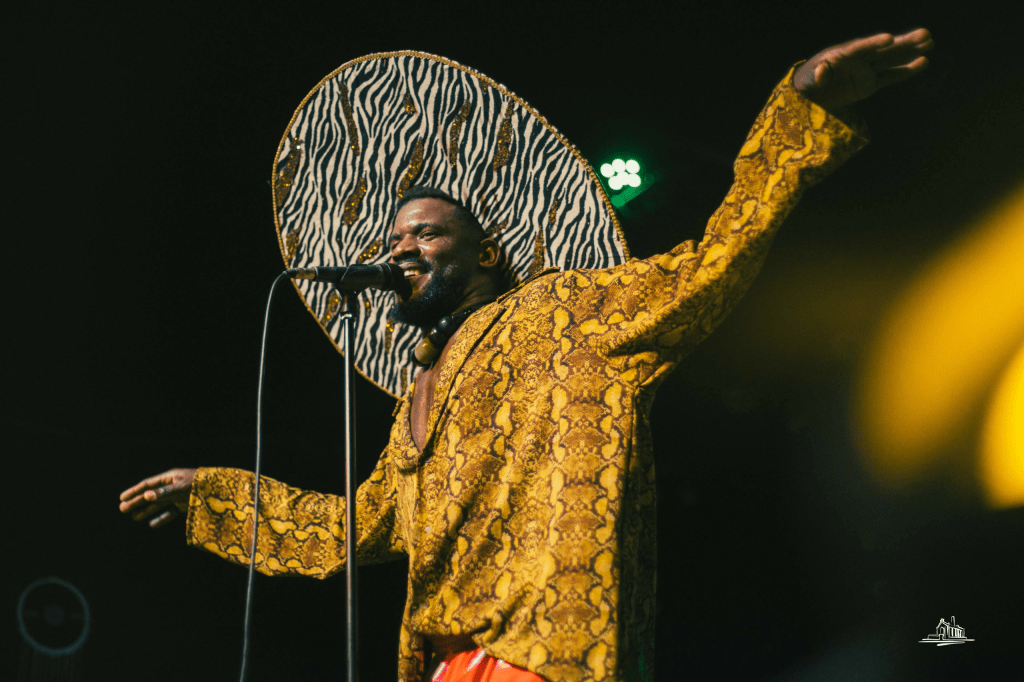
But the big thing was the fashion. The first time I saw the hat, several times in the space of a week or so, in the Havana event-listing Whatsapp group Aguacero (Watershed) I wasn’t sure whether to take it seriously. Gold, a metre wide, theatrical to the point of absurdity. But absurdity is not accidental, and it got me to that first concert
With a background in art history, Gabo thinks visually. Colour is argument. Fabric is language. He discovered the Congolese Dandys —reclaiming flamboyant elegance as coded defiance — and something clicked. Why should Black masculinity in Cuban media be restrained to muted palettes? Why not pink, red, sequins, wide-legged trousers that blur gender expectations?
When someone commented on national television that the hat looked badly cut, he didn’t retreat from it. He lined it with sequins. He made it brighter. A contrarian aesthetic became strategy – the silhouette said what words might not. But again, reality bites “I realised that a clothing brand is a much more objective and profitable business model than music, and that in my case it could accompany very well the work I was developing… from an economic point of view it could sustain, support and accompany Vita Música” he told us.
After the Lights
When the set ended at Fábrica, the electricity had held. The crowd lingered. Outside, Havana remained half-lit. No cabs, money or no money, I walked home, thinking again about Bowie, about underdogs in dimmed countries, about audacity as a creative act. I bet those screaming fans tell grandchildren how it changed things. The comparison is imperfect. Havana is not London. Vita Kará is not Ziggy Stardust. I don’t get how England likes to smash up its good stuff, like punk slaying the heroes of the sixties. That’s not the Cuban way. Supporting emerging music in Cuba does not mean dismissing trova, son, or the monumental weight of heritage. Benny Moré does not require defiance (neither did the Rolling Stones), but there has long been a tendency to reduce Cuban music to genre and let the individual dissolve into tradition. Vita Kará resists that dissolution. He understands indistinguishability is erasure and persona is survival. He is not rejecting Cuban tradition but he is refusing to blend in invisibly. Emergence is not a rejection of the past, but a negotiation for visibility.
Its very dark but I feel excited.

 El Grito