It was Saturday night. The thermometer read thirty-six degrees, and the air felt sticky. The high temperatures already betrayed the arrival of summer on this Caribbean island, where the sweat brought on by good music is part of our idiosyncrasy. I was sitting on the terrace of the newly opened Bongo Loco bar, an old house with colonial architecture, huge windows and a broad terrace like many of those found across Havana, but this one promises to be a new refuge for young Cuban artists looking for a place to express their art, as is the case with my interviewee on this occasion, whom I was waiting for.
I had arrived a couple of hours before the concert began. The bar’s generator cut out three times. Each time the lights went off, I watched the musicians turn on their phones and carry on rehearsing. An ordinary situation, any Cuban would say: the uncertainty of endless blackouts is already part of the soundscape and the routine of our daily lives.
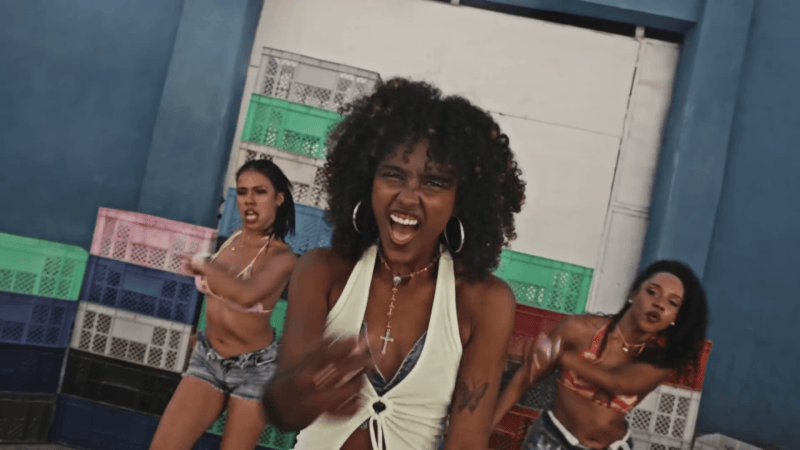
My interviewee came through the door and spotted me among the crowd. Cannela — only 19 years old, with afro hair like mine — has forced her way into the Cuban music scene with songs such as La Noche, Cadenas and Ángeles. Sometimes her voice is as soft as a Havana sunset; at others, it turns into a growl announcing her arrival like the beginning of hurricane season. A young woman confidently making her way into the male-dominated reparto scene. You might say it takes cojones, but she proves it doesn’t.
As I sit down with Cannela, I watch her being greeted again and again by musicians, friends and followers. The atmosphere is informal but extraordinary, like a house party where one of your friends has just become a star. Everyone there has some connection with Cannela and seems magnetised as she commands the attention. I suppose it is universal, but especially in Cuba, the paradox between the glamorous public personality of an emerging artist and her real life is striking. And, as it turns out, that becomes the heart of this story.
A Musical Baptism, the Alter Ego as a Form of Resistance, or Simply the Birth of a Diva
As we exchanged our first words, the first question became clearer in my head. My curiosity about that unusual and very Cuban name was overwhelming. Was it a character? A state of mind? An invention? So, without any hesitation, I asked my first question.
I doubted her parents had called her Cannela. We don’t know the people Benito Martínez, José Manuel Carbajal Zaldívar or Stefani Germanotta in the way we know the personalities Bad Bunny, El Taiger and Lady Gaga.
How did you get your name, Cannela?
She told me that her real name is Alejandra, but that the name Cannela came into her life as a joke that stuck when, at sixteen, she decided to wear her afro hair natural and her closest friends began calling her Canela, referring to the Cuban children’s song Estela es un granito de canela [Estela is a little grain of cinnamon]. She had already started uploading her first covers to an Instagram account under her real name and, one day, as a joke, changed the name to Cannela without imagining that the joke could go so far.
Like Cannela, I too am constructing a disguise: a Gonzo journalist persona, trying to establish a style driven by feelings and myth rather than the bland litany of facts we get here: attended this conservatory, won this prize. I remembered Gabo Cárdenas and how he created and then inhabited that larger-than-life personality at the front of Vita Kará. Watching Cannela, watching Gabo, watching myself become Kamila del Grito and make a powerful character an ally, a street cheetah dressed in yellow leather, feels like a firewall against a life of spending $8 of a $15 salary on cooking oil, or crossing the city simply because the shower works at my mother’s house.
Eager to know more about the unknown Alejandra sitting beside me, I asked her:
How much of Alejandra is there in Cannela, and how much is a character necessary to survive, succeed and be desired in Cuba today? Was Cannela born so that you could express yourself, or was she born to be observed?
A little of both. While Alejandra is quiet, calm and quite absent-minded, Cannela, on the other hand, is more active: she dances, sings, puts on a show, talks a lot. That’s the difference — Cannela confesses to me with a thoughtful expression as she moves her afro curls from one side to the other. Although lately I feel as though I tend to merge, because I’ve been so immersed in the world of music that most of the people I associate with already know me as Cannela, and many times, even when I’m not at a concert or recording, I act more freely, more naturally, with more confidence. I talk more; I express myself better.
How do you think it will be in 10 years, when you’ve played the role of Cannela so much that she becomes part of you?
“I think I’d be a hybrid…,” she says, laughing, “something I’ve already been experiencing on two or three occasions.”
For Alejandra, having the character of Cannela has been a great advantage. She feels it is the perfect justification to be whoever she wants, with successes and contradictions. Alejandra and Cannela, two women inhabiting the same body, two artists who do not fight for one to stand out above the other, but complement each other.
From Hobby to the Big Stages
In Cuba, “taking it seriously” often means giving up everything else. What did that mean for you, Cannela?, I asked her, and when did you make that leap?
Cannela always dreamed of “being a singer” and, throughout her youth, that obsession became something more than a hobby. But when she was offered a place to study Medicine, she had to make a decision.
“To tell the truth, it will always be my frustrated dream because I also love everything to do with anatomy,” she told me as though they were words dedicated to a longed-for lover. But in Cuba, studying Medicine meant giving up music completely, an idea she did not like, so she explains:
“My own mother told me: ‘If you want, wait a year and choose a course that demands less of you, or study Medicine.’ I decided to wait.
It was from that decisive moment in her life that she began to develop the character of Cannela through her songs. Her voice becomes firmer as she tells me:
“I tried to find producers, to inform myself, above all to keep learning. I’m still doing it. It has been a gradual process.”
Cuban Glamour: a Lifestyle, a Pose, Longing for a Distant Past, or a Form of Resistance to Everyday Reality?
In the 40s and 50s Paseo del Prado was a splendid and exotic urban catwalk, like the very essence of Cuban women. Legends such as Celia Cruz and Rosita Fornés set trends and the Cuban look reverberated through London and Paris. The Cuba of 2026 is brutally different. Dressing has become little more than a basic necessity. I wanted to know what it meant for Cannela to have created a public personality that challenged the rules.
Her videos project confidence, glamour and control but hint at Cuba’s everyday reality. How, I ask her, do those two versions of her life live together without one ending up contradicting the other?
Cannela declares herself to be an ordinary Cuban woman, aware that she lives in two very different worlds.
“When I’m in the studio or on stage, I disconnect. I try to leave all my everyday life as a Cuban outside.”
She tells me how, at times, it has been shocking to go to a luxurious bar where supposedly nothing is happening, where supposedly everything is fine, and then arrive home where the lack of electricity complicates and hardens her daily life.
Looking from Cuba to England, the glamour looks real to me – artists have image consultants, luxury lifestyles and an industry structure that sustains the myth. On this island, for Cannela and her like, whose rehearsals and concerts are interrupted or cancelled by as often as not, finding transport to move her band’s instruments is an impossible mission. Seeing a girl of only nineteen years old makes me ask myself how much invisible effort lies behind that perfect image. “Do you think glamour is a form of rebellion in Cuba?” I ask. “Because many times looking like an artist requires more imagination than money.”
“Totally. Almost by obligation you have to resort to imagination, both to dress with glamour and to be original.”
The Barrio as a School
Cannela lives in Reparto Martí, a working-class neighbourhood in Havana. “I used to live somewhere quiet,” she tells me, but moving there changed the way she understands the music she now performs.
“Being in a neighbourhood where you hear a lot of reparto helps me understand why the lyrics are the way they are, their flavour, their rhythm. Above all, that rhythm that makes you move, that makes you dance.”
She isn’t simply talking about listening to a musical genre. She’s talking about living inside it, understanding it from the streets where it was born and where it remains the soundtrack of everyday life.
“And that’s what interests me: adapting it to the kind of music I make.”
She doesn’t want to copy reparto. She wants to absorb what makes it work.
Her ambition, she explains, is to become a versatile artist.
“Trying to make a reparto that is less vulgar, a reparto that makes you dance, that doesn’t just leave you a little dazed, but makes you move on another level. A repertoire that can make you dance a lot, but also makes you listen to the lyrics or sit down and interpret what the song is saying.” She explains that by “less vulgar”, Cannela means the lyrics, not the rhythm. For her, reparto doesn’t need obscene lyrics to make people move; cleaning up the words is an artistic choice, not an attempt to make the music more acceptable to an international audience.
Listening to her, I understood that Cannela does not reject reparto or intend to turn it into something else. She wants to preserve its energy, its rhythm and its ability to make people move, but she also wants to invite them to listen carefully to what the songs are really saying.
How would you define reparto?
“Reparto is music that comes from living through adversity. It’s a joyful way of living, and that is what has always distinguished Cubans.”
The Misogyny of Reparto
Reparto was born in Havana’s most marginal neighbourhoods around 2007. As its name suggests, its songs were a musical cry from that harsh urban marginality. The lyrics spoke of sex, drugs and the codes of the street. Today it has spread until it has undoubtedly become the sound most Cubans prefer. It is a musical genre that has generally been an almost entirely male ecosystem. Women, as in reggaetón, were often expected simply to provide the image.
Then Cannela arrived, building a career in this genre with a voice that seems to say “I can do this too—and better.”
So, I ask, “I think it’s fair to say that you project a very modern image of Cuban femininity. In your videos there is a confident sexuality and an assertion of your right to belong in reparto culture, which at times has been extremely misogynistic. Has it been easy? And do you think it’s easier now than it would have been for someone in your position twenty years ago?”
“It really isn’t completely easy. Because women are almost always decorative objects, both in reggaetón and in reparto. Many times the public pays more attention to the pretty image than to the music itself… although over time women have been taking on an increasingly firm role in the industry.”
Her answer made me wonder whether Cannela is trying to do more than simply succeed as a woman in reparto. Is she also trying to change what reparto itself can be?
I ask “Listening to your songs, they seem to move from bolero to reparto, from pop to afrobeat. Is it more important to you to evolve reparto than simply to fit inside it?”
“Above all, my aim is to demonstrate the union between the classics of traditional Cuban and international music with the new sounds of my country, known as reparto. Afterwards, to demonstrate my versatility. I love cultural and genre diversity: reggaetón, afrobeat, rap, hip hop, jazz and R&B.”
And there was the key: Cannela isn’t making the reparto everyone expects, she isn’t following the song formula and other artists who followed the formula and succeeded. Cannela is redefining reparto, taking traditional Cuban music with genres such as bolero and merengue and mixing it with afrobeat, pop and jazz. She is building bridges where before there were only walls.
A Song or a Confession in Disguise
The night before the interview, I sat in my rented apartment in Centro Habana with a menthol cigarette in my mouth, enjoying Cannela’s songs while scrutinising every last lyric in my thoughts. “Sometimes I sit alone and drink / Sometimes I smoke to erase memories,” she sings in Cadenas. I wondered whether that was autobiography or performance; the line between the two in art is so thin that sometimes it disappears.
Has there been a song in which Alejandra appears more than Cannela?
“In all my songs I’m always much more Cannela than Alejandra,” she confessed to me. “However, there is one that touches me deeply, and that’s Ángeles. I wrote it from the pain and sadness of losing a loved one. It was the first song I released, as a tribute to one of the people I loved most when they were alive. That’s why I wrote a decisive and more creative story, one that came more from Alejandra’s mind than Cannela’s.”
Ángeles isn’t a reparto song, it’s a bolero, a confession, a farewell. And it is proof that Cannela can navigate between genres as she navigates between identities.
The Cuban Motomami
Motomami – Rosalía’s concept combining strength and vulnerability, tradition and modernity.
When I watched the video for Enamorate, I couldn’t help thinking of the video for Berghain by Rosalía, undoubtedly one of the Spanish artist’s most recent successes. The same visual ambition, the same blend of the old and the new, the same declaration that art has no borders.
“Rosalía inspires me,” Cannela admits. “The fact that she keeps going despite everything, how she has reinvented what already existed, without being afraid of being judged. How she has complete ownership of what she does.”
But there is something deeper. Cannela identifies with the debate that Rosalía has generated: reinventing a tradition without losing your roots.
“Rosalía has received criticism for reinventing a tradition. I talk about modernising Cuban music without losing my roots. I identify with that debate.”
And when I ask her what she considers revolutionary about Rosalía, her answer is simple but powerful:
“Her willingness to fail and to learn. It’s incredible.”
Cannela also tells me how she grew up listening to both traditional and contemporary music, including Orishas, who have also inspired her through their fusion of hip hop and rap with Cuban music—elements that are clearly present in her own work. Cannela describes herself as a soul in constant evolution, always studying and creating something new, just like Rosalía.
But her greatest love is Nathy Peluso. “I identify with Nathy Peluso and her persona for many reasons. First, as women, through her song lyrics; and also, in general, her incredible versatility, which I aspire to achieve in my own music.”
It is easy to see why. The Argentine-born, Spain-raised Peluso has made refusing musical boundaries almost a principle: her debut album Calambre moved between salsa, R&B, hip-hop and classic Argentine pop, while GRASA later combined rap, salsa, ballads and tropical sounds. She also studied physical theatre before establishing herself as a musician, which helps explain the intensely physical, theatrical stage presence for which she has become known.
Cannela singles out Remedio, from GRASA, as the song in which that identification becomes most personal: “Personally, ‘Remedio’ means a lot to me, as it’s a song about overcoming adversity and emphasizes the importance of falling down and getting back up. Ultimately, Nati Peluso’s own personality is reflected in the song, in my career, and in my music as well, because it stresses that you’re invincible, that it’s always been that way, and that giving up isn’t an option. It’s a theme of overcoming adversity that repeats itself time and again, simply with the message of always keeping going, regardless of the moment, the circumstances, the people, etc.”
Remedio was released on GRASA in 2024, and Peluso herself co-wrote and produced it; its refrain centres precisely on refusing to give up.
A Viral Song and the Internationalisation of Reparto
“La Noche me anda buscando,” [The Night is looking for me] you sing in La Noche, which went viral. Was that the moment when you realised your music could connect with an international audience?
“I think so, and I’m honestly very proud of that,” she replied with a smile that lit up the terrace. “Connecting with people makes me very happy. Other songs had reached people before, but not on this scale. Especially in Spain and among Cubans living in the United States.”
So when you write your songs, are you writing only for a Cuban audience, or are you trying to reach an international one?
“Yes, my goal is to reach a more international audience,” she said. “However, I think that whatever genre I make, there will always be a little bit of Cuba in everything I do, especially in the traditional sense. I will always defend my roots.”
Cuban reparto, the genre that many dismiss as nothing more than “music from the neighbourhoods,” is beginning to conquer the world. But can it become a truly international genre? That is the great question people who know the genre are asking. Cannela is part of that vanguard, taking the sound of Cuban reparto into territories that once seemed inaccessible. For her, to paraphrase her own words, it is only a matter of time before reparto reaches even further.
The Final Question: How Does She Want to Be Remembered?
The interview was drawing to a close. My final question came almost as spontaneously as the first.
If, in ten years’ time, people speak about the “Cannela sound”, how would you like to be remembered?
She paused to think for a moment. The noise of the bar seemed to fade as the silence settled between us.
“For music that reaches beyond musical genres and beyond the written score,” she said. “Something authentic. Something that keeps reinventing itself.”
Cannela said goodbye as though we had already become close friends. Half an hour later, the bar plunged into darkness during yet another unexpected power cut and a hundred points of light from the phones of the audience who had come to see Cannela illuminated the stage. Cannela walked on. Loose curls. Bare feet. A stage presence that took your breath away. For a moment I felt as though I were in some club in London. But no. We were in Havana, where a voice like Cannela’s lights up a city living in the shadows.
And as my eyes delighted in her talent, I understood the most important thing about the evening. It no longer mattered whether Cannela was “real” or a character. It no longer mattered whether her lyrics were autobiographical or invented. What mattered was that she exists. That her music is heard. That her image challenges all of us to become more, to dream more. That, dear readers of El Grito, is the true glamour of Cuba.


